The Inevitable Season
There’s a saying that there are only two certainties in life: death and taxes.
Death… well, working in film has occasionally put me closer to situations where safety became very real, very quickly. That’s a story for another time, but it’s enough to say that freelance life on set isn’t always as controlled and predictable as people imagine.
Taxes however, show up every single year without fail.
And if you’re a freelancer working in film, it isn’t just mildly inconvenient — it’s a full organizational exercise in patience, paperwork, and trying to decipher documents that oftentimes feel like they were written in Klingon.
Not Your Standard Paycheck
For someone with a single salaried job, tax season is relatively straightforward. One employer. One payroll company. One or two tax documents.
Working in film doesn’t look like that.
Every project is short-term. Every company pays differently. Some productions run through payroll, meaning taxes are taken out before I even see the money. Others pay after I send an invoice and a W9 — in which case nothing is withheld. And then there are the smaller passion projects where paperwork is minimal and you’re handed cash or a Venmo payment at wrap.
Even payroll jobs aren’t simple.
As a production sound mixer, my pay usually has two elements: labor and gear rental. Labor is taxed at the time of payment. Gear rental typically isn’t. That means pay stubs and year-end tax forms come with multiple columns, line items, and calculations that require a strong cup of coffee to interpret.
And here’s the fun part: every project generates its own tax document.
Even if two productions use the same payroll company, I’ll still receive separate forms for each individual job. By the time tax season rolls around, it feels like I’m assembling a jigsaw puzzle made entirely of paperwork.
Working Across State Lines
Then there’s state tax.
Film work doesn’t politely stay inside one state boundary. If I work in another state, sometimes there are local taxes to pay. Sometimes not. It depends entirely on that state’s tax code and the structure of the job.
So now we’re not just organizing federal forms — we’re navigating multiple states, each with their own rules.
The World of Deductions
Freelancing isn’t just about income. It’s also about expenses.
There are the shoot-specific costs — items I purchase and then bill back to production. Those reimbursements often show up on a 1099, meaning they look like income. But they zero out when I claim the actual expense I incurred. It balances out in the end — but only if everything is documented correctly.
Then there’s the cost of running a freelance production sound business:
• Equipment purchases
• Equipment maintenance and repairs
• Gear rentals when a job exceeds my inventory
• Additional crew labor (when I’m paid and then I pay my team)
• Business mileage
• Travel and meals
• Marketing costs
• Website hosting — including this very blog
• Utilities and miscellaneous office expenses
Every one of those items becomes a potential deduction. And the more accurately you track them, the more accurately your tax liability reflects reality.
Even small expenses matter. They add up quickly over the course of a year.
There’s also the ongoing question every freelancer faces: Is that new piece of equipment a one-time write-off? Or a depreciating asset over several years? The answer isn’t always obvious.
The Personal Side of It All
And of course, business taxes aren’t separate from life.
There are personal deductions, healthcare costs, savings, investments — all the normal financial pieces that affect a tax return. Being self-employed means your professional and personal finances intertwine more than you might expect.
When I first moved to the United States, I had no idea how the tax system worked here. Compared to what I’d dealt with in the UK, it felt infinitely more complex. Why one developed country structures tax season one way and another does it differently is far above my pay grade.
My passion was never to become a businessman, executive, or financier.
I wanted to work on set. I wanted to collaborate creatively. I wanted to use the craft of production sound to build a life for myself and my family. If I’d wanted to spend my days buried in financial spreadsheets, I would have gone to business school instead of film school.
The financial side of freelancing is simply the price of admission.
Learning the Hard Way
In the early years, when I was still establishing myself, I handled everything using TurboTax.
At that stage, my projects were smaller, the paperwork was manageable, and plugging numbers into software once a year felt reasonable. Enter the documents. Log the receipts. Answer a few questions. Get a number.
Simple enough.
Until the year it wasn’t.
One year, I received a letter from the IRS claiming I owed more than what the software calculated. I had entered everything I had. I double-checked my math. I wrote letters back and forth trying to understand the discrepancy.
No clear explanation.
No satisfying resolution.
Just the feeling that maybe freelance tax law requires the analytical abilities of a Fortune 500 CFO.
That was the moment I realized I needed professional help.
Hiring an Accountant
Around the same time, my wife was building her private therapy practice. Like me, she wants to help people — not become a bookkeeper.
We found an accountant familiar with both the entertainment industry and medical practice finance. He understands the nuances of how freelance creative businesses operate.
His fee isn’t insignificant.
But neither is the peace of mind.
He knows the legal ways to minimize tax burden. He understands depreciation, multi-state filings, industry-specific deductions. And most importantly, he gives us confidence that what we file aligns with what the IRS expects.
The time saved alone is worth it.
Now our job is to collect documents, organize receipts, track expenses carefully — and then hand it off. Instead of spending days buried in tax software hoping the final number is correct, I can focus on what I actually enjoy: working in production sound and continuing to develop my craft.
A Necessary Evil
I still don’t enjoy tax season.
I still don’t look forward to assembling paperwork.
But I understand it now as part of running a professional freelance business.
Behind every boom pole and mixer bag is a small business owner managing cash flow, investments, depreciation schedules, and compliance with federal and state tax codes.
Tax season may not be glamorous, but it’s part of the ecosystem that allows me to work as a freelance production sound mixer. So I’ll keep my receipts, respect the deadlines, and leave the complex calculations to someone who genuinely enjoys them.
And once it’s all wrapped, I can return to the far more enjoyable challenge of capturing clean dialogue in unpredictable conditions — which somehow feels simpler than decoding a pay stub.



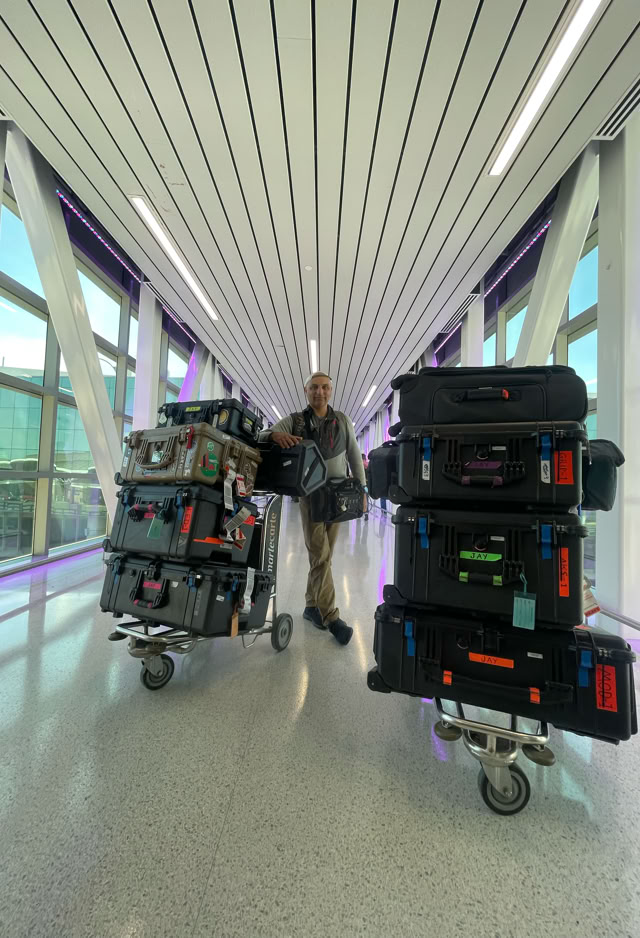


Martin Kittappa is an Emmy nominated production sound mixer and certified drone pilot with 20+ years experience working on film and TV productions around the world. A self proclaimed tech nerd. Lover of heavy metal music an avid runner, cyclist and a moderately good skier You can also check out out his YouTube Channel ‘The Full Later life’
Why I love working in film
OSCARS, Razzies and the A-List

© Martin Kittappa Production Sound 2026